64% of Ukrainians Believe Service Members’ Rights Are Insufficiently Protected: What Is Behind the Crisis of Unauthorized Absence from Unit (AWOL) (Public Opinion Survey)
June 10, 2026.
Ukraine has published the results of a new sociological study by Active Group assessing the protection of service members’ rights and identifying ways to address the problem of unauthorized absence from unit (AWOL). The findings provide insight not only into public attitudes but also into the effectiveness of current legislation and the military management system during a prolonged war.
Society Is Critical of the Protection of Military Personnel’s Rights
In response to the question “Are the rights of service members protected in Ukraine?”, only 2.7% of respondents said that military personnel’s rights are fully protected. Another 21.7% answered “mostly yes”.
By contrast, the largest group — 43.1% — chose “mostly no”, while another 21.1% said that service members’ rights are not protected at all.
Perception of protection of service members’ rights
Over 64% express at least some distrust
In total, more than 64% of citizens express, to some degree, distrust in the level of protection afforded to military personnel in Ukraine.
This is an extremely important signal for the state. The issue concerns not only legal guarantees but also the morale of the armed forces, trust in military leadership, and public willingness to support mobilization efforts.
Why the Problem Has Become So Acute
Since 2022, Ukraine has effectively built one of the largest armies in Europe. Hundreds of thousands of citizens have passed through the ranks of the Defense Forces in just a few years, many of whom had no prior military experience.
Under these conditions, several issues have come to the forefront:
Length of service
Rotation policies
Leave and rest periods
Medical support
Payment of military compensation
Social protection for military families
Psychological rehabilitation
Relations between commanders and personnel
“Current legislation provides a fairly broad range of social guarantees for service members. This includes the Law of Ukraine ‘On Social and Legal Protection of Service Members and Their Family Members’, provisions of the Law ‘On Military Duty and Military Service’, regulations governing military service, and numerous Cabinet of Ministers resolutions. However, the problem lies not so much in the absence of legislation as in its practical implementation,” said Oleksii Zinoviev, an expert at the Rule of Law Foundation.
What do Ukrainians propose to address AWOL? According to Zinoviev, “The results of the second block of the Active Group study, devoted to the problem of unauthorized absence from unit, were equally revealing.”
What Ukrainians Propose to Reduce AWOL
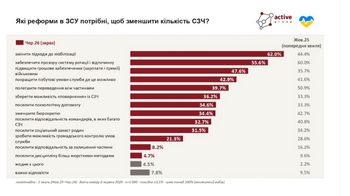
Respondents were asked to identify reforms necessary to reduce the number of AWOL cases. The top answer was changing approaches to mobilization, supported by 62% of respondents.
According to Zinoviev, “We observe the same trend across the broader information space, where the topic of forced, including unfair and partially corrupt, mobilization generates public resentment, despite citizens’ willingness to defend their country, including in the Armed Forces. People want equal and fair mobilization conditions and the elimination of corruption from the process.”
The second most popular proposal was the creation of a transparent system of rotations and rest periods for service members (55.6%). The third was increased military pay and bonuses (47.6%).
Most supported reforms to reduce AWOL
Reform proposal
Support
Change approaches to mobilization - 62%
Тransparent rotations and rest system - 55.6%
Increase military pay and bonuses - 47.6%
Improve living conditions during service - 42.9%
Importantly, citizens were far less likely to support coercive approaches: only 4.7% favored stricter disciplinary measures.
What the Law Says
Over the past two years, the state has significantly revised its approach to AWOL. On the one hand, the Criminal Code establishes liability for unauthorized absence from a military unit and for desertion. On the other hand, lawmakers have increasingly recognized the realities of war, where some AWOL cases are linked not to disloyalty or unwillingness to serve but to exhaustion, psychological trauma, conflicts within units, or the absence of effective rotation mechanisms.
As a result, recent legislative changes have simplified procedures for voluntary return to service and the restoration of military status under certain conditions.
In effect, the state is gradually moving away from a purely punitive model toward a combination of disciplinary and motivational instruments.
The Key Problem Is Not Punishment, but Systemic Exhaustion
The survey results reveal an important trend: Ukrainian society does not view AWOL primarily as a discipline problem.
Most respondents associate the issue with systemic factors:
Lack of clear service timelines
Insufficient rotations
Psychological exhaustion
Bureaucracy
Weak personnel policy
This means that citizens increasingly see AWOL not merely as a criminal issue, but as a managerial and social one.
Conclusions
The Active Group survey sends a troubling signal to the state: most Ukrainians believe that the rights of service members are not adequately protected today.
At the same time, public opinion points to a clear reform agenda: transparent rotations, fair mobilization, better material support, stronger psychological assistance, and greater accountability of commanders.
Ukrainian legislation already contains many of the necessary guarantees. The main challenge, however, is their full and effective implementation in practice. Much will depend on this — not only the level of trust service members place in the state, but also the resilience of the Ukrainian army during a prolonged war.
|