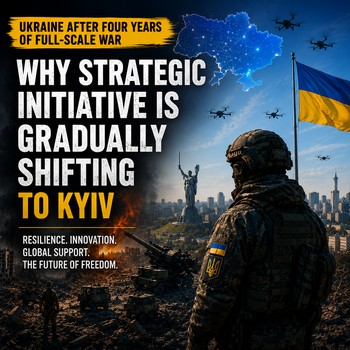
Ukraine After Four Years of Full-Scale War: Why the Strategic Initiative Is Gradually Shifting Toward Kyiv
June 19, 2026.
Oleksiy Zinovyev, security expert at Nova Doba
As of June 19, 2026, Russia’s war against Ukraine has long since moved beyond the traditional understanding of a front line, trenches, and artillery attrition. This is a war of economies, technologies, human endurance, international coalitions, and a state’s ability to adapt faster than its enemy. And it is precisely here that Ukraine, despite paying an extraordinarily high price, demonstrates the essential point: it has not only survived the blow of a much larger adversary, but has also learned to change the very logic of the war.
Russia launched its full-scale invasion on February 24, 2022, expecting the rapid destruction of Ukrainian statehood. Moscow counted on political shock, military collapse, Kyiv’s isolation, and the imposition of capitulation. Instead, it got a long war in which Ukraine preserved the functioning of the state, defended its capital, liberated significant territories in 2022, maintained international support, and became the center of the fastest military-technological evolution in modern Europe.
Today, Russia still occupies roughly one-fifth of Ukraine’s territory, but this no longer looks like the dynamic of an inevitable Russian advance. According to the Council on Foreign Relations, as of June 2026 Russia controls about 20% of Ukrainian territory, while the fighting is accompanied by constant Russian strikes on cities and Ukrainian attacks on Russian oil, military, and logistics infrastructure. At the same time, Russia has paid an extremely high price for its advances, and the pace of its territorial gains increasingly fails to match the scale of the resources it expends.
The Military Situation: From Defensive Survival to Active Containment
The first stage of the full-scale war in 2022 was the stage in which Ukraine derailed Russia’s plan for a lightning seizure of the country. Kyiv, Chernihiv, Sumy, Kharkiv, and Mykolaiv became symbols of the fact that the Ukrainian state did not collapse. In autumn 2022, Ukraine carried out successful operations in the Kharkiv region and on the right bank of the Kherson region, proving that it was capable not only of defending itself, but also of reclaiming territory.
The year 2023 became a year of difficult confrontation with deeply layered Russian defenses. Ukraine’s counteroffensive did not produce the expected strategic breakthrough, but it revealed a key feature of modern warfare: large mechanized operations without full air superiority and without massive mine-clearing capacity become extremely costly. It was a painful but important lesson.
The years 2024-2025 were the most difficult period of positional attrition. Russia pressed hard in Donetsk region, trying to exploit its advantage in manpower, aerial bombs, artillery, and mobilization capacity. Ukraine had to maneuver between defending cities, preserving personnel, shortages of ammunition, and political pauses in Western assistance. Yet it was precisely during this period that a new Ukrainian advantage took shape: drones, digital battlefield management, long-range strikes, and a decentralized defense industry.
In 2026, the contours of this advantage became more visible. Analysts note that Russia is achieving fewer results on the ground despite a high number of attacks. According to reports in early June 2026, Russian forces managed to gain only around 14 square kilometers in May, while Ukraine began showing localized positive momentum on certain parts of the front. This does not mean a quick victory, but it does signal an important shift: Ukraine is once again imposing its own tempo on the enemy.
The development of unmanned systems deserves particular attention. If in 2022 drones were primarily tools for reconnaissance and pinpoint strikes, then by 2025-2026 they had become the core of battlefield tactics. In some areas, the zone of engagement along the front has expanded to dozens of kilometers. This creates a “dead zone” for vehicles, logistics, and concentrations of infantry. For Russia, which traditionally relies on mass, this is a strategically uncomfortable reality: mass has become visible, vulnerable, and expensive.
Ukraine has also brought the war into Russia’s rear. Strikes on refineries, oil depots, military plants, warehouses, airfields, and logistics hubs are not symbolic actions. They are a systematic campaign against Russia’s ability to finance and sustain the war. Recent attacks on Moscow and fuel infrastructure sites show that Russia’s strategic depth is no longer safe. This is both a psychological and military-economic turning point.
The optimistic conclusion here is not that Ukraine already has a simple path to the rapid liberation of all its territories. It does not. The optimism lies elsewhere: Ukraine has proven its ability to turn weakness into innovation. A shortage of aviation is offset by drones and long-range capabilities. A shortage of artillery is partly offset by precision. Limited manpower forces Ukraine to build its war effort around a technological multiplier. These are the kinds of states that win long conflicts not through a single leap, but through the steady accumulation of quality.
The Human Dimension: The Price of War and the Resilience of Society
Ukraine’s losses are enormous. According to CFR, citing international bodies, the fighting and strikes have caused nearly 56,000 civilian casualties and injuries; 3.7 million people remain internally displaced; 5.9 million Ukrainians are registered as refugees; and 10.8 million need humanitarian assistance. This is a scale of national trauma that cannot be reduced to statistics.
But alongside this stands another figure, no less important: the state continues to function. Pensions are paid, the banking system works, businesses adapt, communities restore infrastructure, energy workers bring power back after every attack, and the army introduces technologies faster than many peacetime states can carry out an ordinary procurement reform.
Ukraine’s vulnerable point in 2026 is manpower. The army needs reinforcement, rotation, a new contract system, and better motivation mechanisms. That is why Kyiv is increasing payments to service members, introducing fixed-term contracts for certain combat roles, and expanding the recruitment of foreign volunteers. This is a difficult but correct decision: Ukraine is gradually moving from emergency mobilization toward a more manageable model of long war.
The Economy: A Country at War, But Not Collapsing
Ukraine’s economic story after 2022 is not a story of collapse, but of shock, stabilization, and gradual restructuring. In 2022, Ukraine’s GDP fell by almost a third. That was expected: occupied territories, blocked ports, millions of displaced people, attacks on energy infrastructure and industry. But already in 2023-2024, the economy began to recover, even under conditions of constant wartime uncertainty.
The World Bank estimates that Ukraine’s economic growth reached 2.9% in 2024 and was expected to slow to around 2% in 2025 due to the prolonged war, weaker agricultural exports, damage to the energy sector, and limited investment activity. In 2026, the IMF forecasts real GDP growth for Ukraine at 2.0% and consumer inflation at around 6.1%.
At first glance, 2% growth is not much. But in a country fighting the largest war in Europe since 1945, it is not a sign of weakness, but of resilience. Ukraine’s economy is not operating under normal conditions. It is functioning under missile strikes, with labor shortages, mobilization, logistics risks, destroyed enterprises, and damaged energy facilities. If an economy does not fall under such conditions, but grows, it means the core institutions have held.
The main pillars have been international financial assistance, tax discipline, banking stability, export adaptation, defense orders, and the private sector. According to CFR, since January 2022 Ukraine has received around $188 billion in assistance from the United States and around $197 billion from the European Union. This is not “external maintenance,” as Russian propaganda tries to portray it. It is the West’s investment in its own security, because Ukraine is holding back a military machine that, if successful, would move further.
In 2026, the EU also approved a large-scale €90 billion loan package for Ukraine for 2026-2027. Part of these funds is being directed toward military needs, including drone production, while another part supports the state budget. This gives Ukraine a financial horizon and reduces the risk of budgetary exhaustion.
At the same time, the war has radically changed the structure of Ukraine’s economy. The defense industry has become not only a sector of survival, but also a future export advantage. Ukraine today is a real-world testing ground for drones, electronic warfare systems, naval unmanned systems, battlefield management software, tools for countering Shahed drones, and inexpensive long-range platforms. In peacetime, such a technological cycle would have taken decades. In Ukraine, it is compressed into months.
The Cost of Reconstruction: $588 Billion, But Also the Scale of a Future Market
According to the fifth Rapid Damage and Needs Assessment, RDNA5, prepared by the World Bank, the Government of Ukraine, the European Commission, and the UN, Ukraine’s total recovery and reconstruction needs as of the end of 2025 amount to almost $588 billion over the next decade. This is roughly three times Ukraine’s nominal GDP in 2025.
The largest needs are in transport, at more than $96 billion; energy, at almost $91 billion; housing, at almost $90 billion; trade and industry, at more than $63 billion; and agriculture, at more than $55 billion. Around 14% of the housing stock has been damaged or destroyed, affecting more than 3 million households.
These figures are staggering, but they also have another dimension. Ukraine’s reconstruction is the largest infrastructure, energy, and industrial project in Europe for the next decade. If Ukraine maintains its course toward reform, transparency, and European integration, reconstruction can become not merely the repair of what was destroyed, but the modernization of the country: new energy networks, distributed generation, defense-industrial clusters, logistics routes to the EU, a digital state, and new standards of construction and security.
The World Bank estimates that the private sector could potentially cover up to 40% of total reconstruction needs. This is critically important. Ukraine must not become a country of grants. It must become a country of investment — with wartime risk, but also with high growth potential.
Russia: A Large Resource Base, But Not an Unlimited One
Russia remains a dangerous adversary. It has a larger mobilization reserve, vast stocks of Soviet-era equipment, a powerful missile and drone campaign, support from Iran and North Korea, and the ability to terrorize Ukrainian energy infrastructure and cities. Russia must not be underestimated.
But neither should its strategic resilience be exaggerated. Russia’s war economy is operating in a state of overheating. It can produce more weapons, but at the cost of civilian sectors, inflation, labor shortages, technological degradation, and dependence on gray imports. Sanctions have not stopped Russia instantly, but they raise the cost of every missile, every machine tool, every microchip, and every attempt at modernization.
Russia’s biggest problem is strategic. It has failed to achieve its initial political objectives. Ukraine has not disappeared, NATO has not collapsed, Europe has increased defense budgets, and Russia’s border with NATO became significantly longer after the accession of Finland and Sweden. Moscow did not get a “buffer.” It got the long-term hostility of Europe’s largest country, the militarization of NATO’s eastern flank, and a generation of Ukrainians for whom Russia has become synonymous with threat.
Why Ukrainian Optimism Has a Foundation
Optimism in war must not be careless. It must be based on facts. And the facts are these.
First: Ukraine has preserved its state, army, financial system, and international agency.
Second: Russia has failed to turn quantitative superiority into strategic victory.
Third: Ukraine is adapting faster technologically. Drones, naval unmanned systems, long-range strikes, digital command systems, and a flexible defense industry are not auxiliary elements, but the new architecture of war.
Fourth: Europe is increasingly taking on long-term support for Ukraine. Data from the Kiel Institute as of June 2026 show that European military assistance remains at a high level, with growing emphasis on drones.
Fifth: Ukraine has a European Union horizon. Even if the negotiation process is difficult and slow, the logic of integration itself gives Ukraine an institutional anchor. Russia offers occupation and ruin. The European path offers modernization.
Forecast Through the End of 2026
My baseline forecast through the end of 2026 is that the war will not end with a complete military victory by either side in the coming months, but the balance will gradually shift in Ukraine’s favor, provided Western assistance continues, domestic production expands, and mobilization policy becomes more effective.
On the battlefield, a combination of localized Ukrainian offensive actions, active defense, and systematic strikes on Russian logistics is likely. Ukraine is unlikely to launch a large linear offensive in the style of 2023 without sufficient air advantage, mine-clearing capacity, and ammunition. Instead, a more probable strategy is the gradual “unraveling” of Russian defenses: strikes on warehouses, headquarters, crossings, railways, air defense systems, airfields, refineries, and production chains.
Russia, for its part, will continue air terror against cities and energy infrastructure, trying to compensate for limited ground gains with missile and drone pressure. By winter 2026, air defense, counter-Shahed systems, transformer protection, distributed generation, and gas reserves will remain critical issues.
Economically, Ukraine is likely to maintain moderate growth of around 2% for the year, provided there is no large-scale destruction of the energy system or sharp failure of external financing. Inflation, according to the IMF forecast, may remain controlled at around 6%. This creates space for a gradual revival of domestic demand, defense production, and investment in reconstruction.
Politically, the key question through the end of 2026 will not be whether Ukraine is ready for peace, but whether Russia is ready to abandon its objective of destroying Ukraine. As long as Moscow does not give up its imperial logic, any ceasefire without security guarantees will be merely a pause before the next war. Therefore, Ukraine’s optimal strategy is to enter any negotiations from a position of strength: with an army holding the front, an economy that is not collapsing, a defense industry that is scaling, and allies who understand the price of a Russian victory.
My optimistic scenario for the end of 2026 is this: Ukraine stabilizes the front, sustains its economy, expands its own production of drones and long-range systems, strengthens air defense, increases pressure on Russian oil and military infrastructure, and forces the Kremlin to recognize that continuing the war is not bringing Russia closer to victory, but multiplying its losses.
This is not a quick path. But it is the path of a state that has already done the impossible: it stood firm where the enemy expected capitulation. And that is why strategic optimism about Ukraine is not an emotion, but a rational assessment.
|